 Promotion: 5% Discount Code: 5vip





Lock Pick Handle Guide: Bare Metal vs Plastic Handles for Comfort and Control
2026-10-07 14:23
A lock pick handle may look like a minor detail, but it can significantly affect how a tool feels during practice. Two of the most common designs are bare metal handles and plastic-covered handles. Bare metal picks are thin, simple, and highly responsive, while plastic handles generally provide a thicker grip and greater comfort during longer sessions. If you are planning to Buy Lock Pick Set from barhomevip, comparing handle materials beforehand can help you choose tools that better match your preferred grip, comfort level, and practice style.
Neither design is automatically better. The right choice depends on hand size, grip style, practice duration, tool thickness, and how much tactile feedback you prefer. This guide compares bare metal and plastic lock pick handles from an ergonomic perspective, helping beginners and hobbyists choose tools that feel comfortable and controllable during lawful lock-sport practice.
| Note: Lock picking should only be practiced on locks you own or have explicit permission to work on.
The biggest difference is not necessarily performance. It is how the pick communicates with your hand.
This produces a very slim profile. Because there is little material between your fingers and the metal shaft, changes in pressure and vibration can feel immediate.
Bare metal handles offer several practical advantages:
Holding a narrow piece of metal for an extended period may create pressure points in the fingers. Users who naturally grip tools tightly may notice discomfort sooner than people with a relaxed grip.
Edges and surface finishing also matter. A well-finished metal handle can feel smooth and comfortable, while rough edges or an excessively narrow profile can become distracting.
The primary purpose is ergonomics.
By increasing the width of the handle, plastic gives the fingers a larger surface to hold. Pressure can therefore be distributed across a broader area instead of concentrating on the edges of a thin metal strip.
For many users, this makes plastic handles more comfortable during longer practice sessions.
Common advantages include:
That difference can be subtle, however, and handle construction matters just as much as material.
Imagine holding a very thin metal ruler between your fingers compared with holding a pen. The pen's larger diameter spreads pressure across more of your fingers. A similar principle applies to lock pick handles.
This becomes particularly noticeable during extended practice.
A thin metal handle may feel perfectly comfortable for several minutes but gradually become tiring. A thicker handle can reduce this problem because you do not need to pinch such a narrow object.
Plastic handles may be especially appealing if you:
A highly sensitive handle can transmit subtle sensations well, but that does not guarantee that it will be easiest to hold steadily.
A thicker plastic handle can provide a more stable gripping platform. Beginners may find it easier to maintain consistent hand positioning because there is more material to hold.
Bare metal, meanwhile, can feel extremely precise because there is little separation between the tool and the user's fingers.
This creates an interesting tradeoff:
Bare metal emphasizes directness. Plastic emphasizes grip stability.
Which produces better control depends heavily on the individual user.
When the tool is one continuous piece of metal, small vibrations travel directly through the shaft into the handle. There is minimal additional material to absorb or soften those sensations.
Plastic can dampen some vibrations, particularly when the handle is thick or soft.
But the difference should not be exaggerated. Feedback is influenced by several factors besides the handle:
A narrow handle concentrates pressure over a relatively small contact area. If you grip too firmly, the fingers can fatigue quickly. Plastic handles spread that load more effectively.
Beginners should pay particular attention to excessive grip pressure. When learning any precision hand skill, it is common to hold the tool more tightly than necessary.
If your fingers become uncomfortable quickly, the problem may not be the pick alone. Consider whether you are squeezing the handle excessively.
A more ergonomic practice setup generally involves:
Because their handles add almost no extra thickness, several picks can be stacked together inside a small case. This makes them attractive for minimalist lock-sport kits.
Plastic handles take more room. One plastic-handled tool might not seem particularly bulky, but the difference becomes obvious when storing a complete set.
For a home practice kit, that extra bulk usually does not matter. For a compact training kit, bare metal may be preferable.
That simplicity can be beneficial over the long term.
Plastic handles can also be durable, especially when properly molded around the tool. Their longevity depends on the type of plastic and manufacturing quality.
Cleaning requirements are straightforward for both styles. Bare metal is particularly easy to wipe down because the surface is continuous.
When comparing tools, inspect areas such as:
Someone who has never used thin precision tools may find a bare metal handle surprisingly narrow. A plastic grip can make initial practice feel less awkward while reducing finger pressure.
However, starting with bare metal is completely reasonable if you value compactness and direct feedback.
Instead of asking which material is objectively best, beginners should evaluate three things:
This can transform a thin tool into something closer to a handled pick while allowing the user to choose the desired thickness.
Possible handle modifications include simple sleeves or purpose-made grip covers. However, adding material changes the balance, thickness, and tactile characteristics of the tool.
For beginners, buying a professionally finished handle is usually simpler than immediately modifying equipment. After developing preferences, customization becomes easier because you know what feels comfortable.
Choose bare metal handles if your priorities include:
A handle that is too short may force your fingers into an uncomfortable position. An extremely wide handle can feel cumbersome for someone with smaller hands. A very narrow handle can cause pressure points for someone with larger hands.
Therefore, when comparing picks, consider the complete ergonomic package:
material + thickness + width + length + edge finishing + stiffness
A well-designed bare metal handle may be more comfortable than a poorly designed plastic one. Likewise, a thoughtfully shaped plastic grip can outperform a thin metal design for long practice sessions.
Bare metal handles are ideal for users who appreciate thin, lightweight tools and direct tactile feedback. Their simple construction also makes them compact, durable, and easy to maintain. The downside is that thin metal can create pressure points during extended practice, particularly for users who grip firmly.
Plastic handles prioritize ergonomics. Their larger gripping surface distributes pressure more evenly and can make tools easier to hold for longer periods. They are therefore an attractive option for beginners and anyone who values comfort. The tradeoff is additional bulk and potentially slightly softer tactile feedback.
For most beginners, plastic handles are the safer choice when comfort is the priority, while bare metal handles are worth considering when sensitivity, portability, and a slim profile matter most.
Ultimately, the best lock pick handle is the one that allows you to maintain a relaxed, controlled grip without unnecessary hand fatigue. Handle material matters, but good ergonomics, quality construction, and proper practice habits matter even more. Once you know whether bare metal or plastic handles suit you better, you can explore Cheap Lock Pick Tools at barhomevip and compare different handle designs, pick profiles, and set configurations for your lawful lock-sport practice.
Neither design is automatically better. The right choice depends on hand size, grip style, practice duration, tool thickness, and how much tactile feedback you prefer. This guide compares bare metal and plastic lock pick handles from an ergonomic perspective, helping beginners and hobbyists choose tools that feel comfortable and controllable during lawful lock-sport practice.
| Note: Lock picking should only be practiced on locks you own or have explicit permission to work on.
Bare Metal vs Plastic Handles at a Glance
Before looking at the details, here is a simple comparison.| Feature | Bare Metal Handle | Plastic Handle |
| Overall thickness | Usually thinner | Usually thicker |
| Weight | Very light | Slightly heavier |
| Tactile feedback | Direct and crisp | Slightly dampened |
| Long-session comfort | Depends heavily on grip | Usually better |
| Grip surface | Smooth metal | More substantial surface |
| Portability | Excellent | Good |
| Cleaning | Very easy | Easy |
| Durability | Simple construction | Depends on handle material |
| Best suited to | Feedback-focused users | Comfort-focused users |
| Beginner friendliness | Moderate | Generally high |
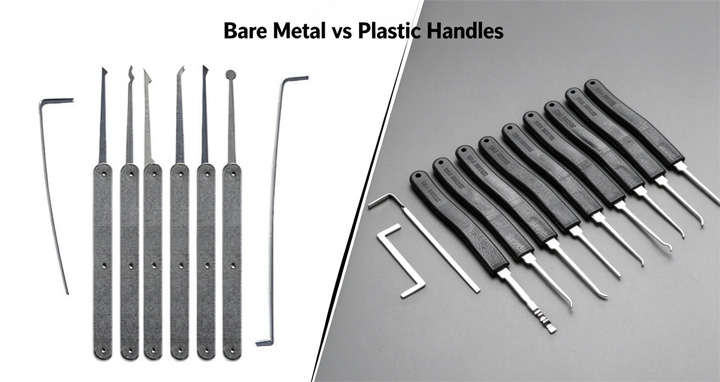
What Is a Bare Metal Lock Pick Handle?
A bare metal handle is essentially an extension of the pick itself. The tool is commonly stamped or cut from a single piece of metal, with no additional plastic, rubber, or molded grip surrounding the handle section.This produces a very slim profile. Because there is little material between your fingers and the metal shaft, changes in pressure and vibration can feel immediate.
Bare metal handles offer several practical advantages:
- Thin and easy to store in compact cases
- Lightweight
- Simple construction with few components
- Easy to wipe clean
- Direct tactile sensation
- Often less bulky when carrying multiple tools
Holding a narrow piece of metal for an extended period may create pressure points in the fingers. Users who naturally grip tools tightly may notice discomfort sooner than people with a relaxed grip.
Edges and surface finishing also matter. A well-finished metal handle can feel smooth and comfortable, while rough edges or an excessively narrow profile can become distracting.
What Is a Plastic Lock Pick Handle?
Plastic-handled picks add a layer of material around the metal handle. Depending on the manufacturer, this may be a molded shell, dipped coating, sleeve, or another synthetic grip.The primary purpose is ergonomics.
By increasing the width of the handle, plastic gives the fingers a larger surface to hold. Pressure can therefore be distributed across a broader area instead of concentrating on the edges of a thin metal strip.
For many users, this makes plastic handles more comfortable during longer practice sessions.
Common advantages include:
- Thicker gripping surface
- Reduced pressure on fingertips
- More secure feeling in the hand
- Easier identification of individual tools
- Better comfort for beginners developing hand control
- Less noticeable metal-edge pressure
That difference can be subtle, however, and handle construction matters just as much as material.
Comfort: Plastic Usually Has the Advantage
If comfort is your highest priority, plastic handles will often be the easier choice.Imagine holding a very thin metal ruler between your fingers compared with holding a pen. The pen's larger diameter spreads pressure across more of your fingers. A similar principle applies to lock pick handles.
This becomes particularly noticeable during extended practice.
A thin metal handle may feel perfectly comfortable for several minutes but gradually become tiring. A thicker handle can reduce this problem because you do not need to pinch such a narrow object.
Plastic handles may be especially appealing if you:
- Have larger hands
- Practice for longer periods
- Experience finger fatigue with thin tools
- Prefer a substantial grip
- Tend to hold tools firmly
Control: Handle Shape Matters More Than You Might Expect
Control is sometimes confused with sensitivity. They are related, but they are not identical.A highly sensitive handle can transmit subtle sensations well, but that does not guarantee that it will be easiest to hold steadily.
A thicker plastic handle can provide a more stable gripping platform. Beginners may find it easier to maintain consistent hand positioning because there is more material to hold.
Bare metal, meanwhile, can feel extremely precise because there is little separation between the tool and the user's fingers.
This creates an interesting tradeoff:
Bare metal emphasizes directness. Plastic emphasizes grip stability.
Which produces better control depends heavily on the individual user.
Tactile Feedback: Why Bare Metal Is Popular
One reason experienced hobbyists often appreciate bare metal handles is tactile feedback.When the tool is one continuous piece of metal, small vibrations travel directly through the shaft into the handle. There is minimal additional material to absorb or soften those sensations.
Plastic can dampen some vibrations, particularly when the handle is thick or soft.
But the difference should not be exaggerated. Feedback is influenced by several factors besides the handle:
- Steel thickness
- Tool stiffness
- Overall length
- Handle construction
- Grip pressure
- Hand position
- Pick profile
Hand Fatigue During Longer Practice Sessions
Ergonomics becomes increasingly important as practice time increases.A narrow handle concentrates pressure over a relatively small contact area. If you grip too firmly, the fingers can fatigue quickly. Plastic handles spread that load more effectively.
Beginners should pay particular attention to excessive grip pressure. When learning any precision hand skill, it is common to hold the tool more tightly than necessary.
If your fingers become uncomfortable quickly, the problem may not be the pick alone. Consider whether you are squeezing the handle excessively.
A more ergonomic practice setup generally involves:
- Relaxed hand positioning
- Comfortable wrist alignment
- Regular breaks
- Tools without sharp handle edges
- A handle width appropriate for your hands
- Avoiding unnecessary grip pressure
Portability and Storage
Bare metal picks have a clear advantage when compact storage matters.Because their handles add almost no extra thickness, several picks can be stacked together inside a small case. This makes them attractive for minimalist lock-sport kits.
Plastic handles take more room. One plastic-handled tool might not seem particularly bulky, but the difference becomes obvious when storing a complete set.
For a home practice kit, that extra bulk usually does not matter. For a compact training kit, bare metal may be preferable.
Durability and Maintenance
Bare metal handles are mechanically simple. There is no outer handle material that can crack, loosen, peel, or separate.That simplicity can be beneficial over the long term.
Plastic handles can also be durable, especially when properly molded around the tool. Their longevity depends on the type of plastic and manufacturing quality.
Cleaning requirements are straightforward for both styles. Bare metal is particularly easy to wipe down because the surface is continuous.
When comparing tools, inspect areas such as:
- Handle edges
- Surface finish
- Connection between plastic and metal
- Signs of loose grip material
- Excessively flexible handles
- Rough manufacturing marks
Which Handle Is Better for Beginners?
For many beginners, plastic handles are a comfortable starting point because the thicker grip feels more familiar.Someone who has never used thin precision tools may find a bare metal handle surprisingly narrow. A plastic grip can make initial practice feel less awkward while reducing finger pressure.
However, starting with bare metal is completely reasonable if you value compactness and direct feedback.
Instead of asking which material is objectively best, beginners should evaluate three things:
- Can I hold the tool comfortably without squeezing it?
- Can I maintain a consistent grip for a reasonable practice session?
- Can I feel feedback without constantly changing hand position?
Can You Add a Handle to a Bare Metal Pick?
Some hobbyists prefer to customize bare metal tools with removable or permanent grip materials.This can transform a thin tool into something closer to a handled pick while allowing the user to choose the desired thickness.
Possible handle modifications include simple sleeves or purpose-made grip covers. However, adding material changes the balance, thickness, and tactile characteristics of the tool.
For beginners, buying a professionally finished handle is usually simpler than immediately modifying equipment. After developing preferences, customization becomes easier because you know what feels comfortable.
Choosing Based on Your Priorities
Rather than focusing only on material, think about how you expect to practice.Choose bare metal handles if your priorities include:
- Maximum compactness
- Minimal weight
- Direct tactile sensation
- Easy cleaning
- Thin tool storage
- A minimalist design
- Long-session comfort
- A thicker gripping surface
- Reduced fingertip pressure
- Easier handling with larger hands
- A more substantial tool feel
- Beginner-friendly ergonomics
Don't Ignore Handle Length and Width
Material gets most of the attention, but dimensions can be equally important.A handle that is too short may force your fingers into an uncomfortable position. An extremely wide handle can feel cumbersome for someone with smaller hands. A very narrow handle can cause pressure points for someone with larger hands.
Therefore, when comparing picks, consider the complete ergonomic package:
material + thickness + width + length + edge finishing + stiffness
A well-designed bare metal handle may be more comfortable than a poorly designed plastic one. Likewise, a thoughtfully shaped plastic grip can outperform a thin metal design for long practice sessions.
Final Verdict: Bare Metal or Plastic?
There is no universal winner in the bare metal versus plastic handle debate.Bare metal handles are ideal for users who appreciate thin, lightweight tools and direct tactile feedback. Their simple construction also makes them compact, durable, and easy to maintain. The downside is that thin metal can create pressure points during extended practice, particularly for users who grip firmly.
Plastic handles prioritize ergonomics. Their larger gripping surface distributes pressure more evenly and can make tools easier to hold for longer periods. They are therefore an attractive option for beginners and anyone who values comfort. The tradeoff is additional bulk and potentially slightly softer tactile feedback.
For most beginners, plastic handles are the safer choice when comfort is the priority, while bare metal handles are worth considering when sensitivity, portability, and a slim profile matter most.
Ultimately, the best lock pick handle is the one that allows you to maintain a relaxed, controlled grip without unnecessary hand fatigue. Handle material matters, but good ergonomics, quality construction, and proper practice habits matter even more. Once you know whether bare metal or plastic handles suit you better, you can explore Cheap Lock Pick Tools at barhomevip and compare different handle designs, pick profiles, and set configurations for your lawful lock-sport practice.